Is It Always the Ear?
“Doctor, could this be coming from my neck?”
It is a question I have been asked many times over 43 years in practice, particularly by people experiencing dizziness, tinnitus, a sense of imbalance, or the strange feeling that one ear is blocked.
Sometimes there is an obvious ear problem. Sometimes there is not. I have also seen patients in whom soft-tissue treatment around the jaw changes a blocked-ear sensation, and others whose dizziness or aural symptoms seem to vary with neck pain, posture or a previous whiplash injury.
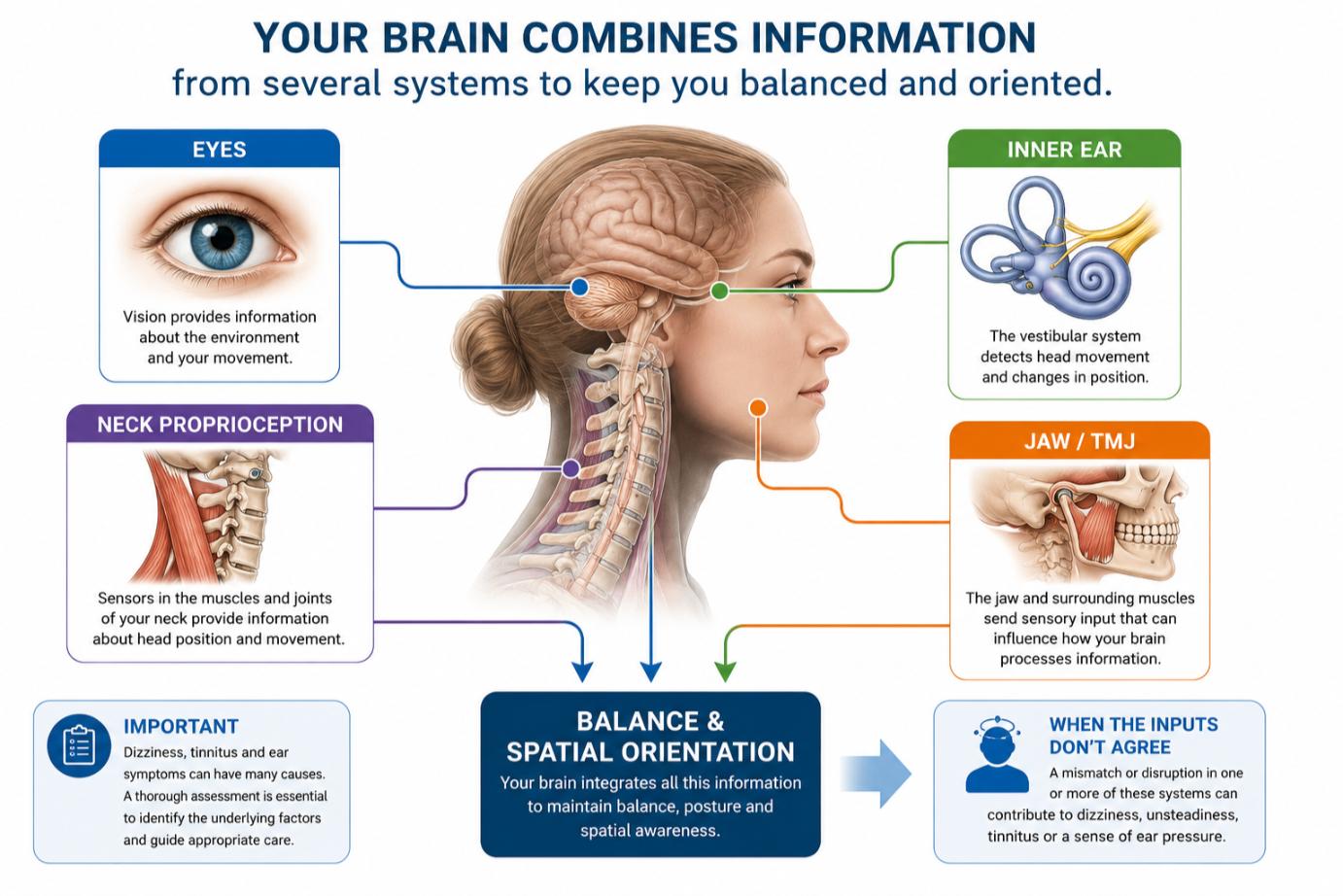
These observations do not mean that every dizzy spell, ringing ear or blocked sensation comes from the neck or jaw. Far from it. They do, however, illustrate something fascinating: the systems that help us hear, balance and orient ourselves in space interact with sensory information coming from the eyes, inner ear, neck and the rest of the body.
Dizziness is a symptom, not a diagnosis
Patients often use the words dizziness and vertigo interchangeably, but they can describe quite different experiences. Vertigo usually involves an illusion of movement – for example, a feeling that the room is spinning. Other people describe light-headedness, swaying, floating, unsteadiness, or simply feeling “off” on their feet.
There are many possible causes, including inner-ear disorders such as benign paroxysmal positional vertigo (BPPV), vestibular migraine, medication effects, cardiovascular problems, neurological conditions and other medical disorders. For that reason, dizziness should not automatically be attributed to the neck.
The neck has a role in our sense of position
The cervical spine contains a rich supply of proprioceptive receptors. These receptors provide the brain with information about the position and movement of the head and neck. That information is integrated with visual and vestibular input to help coordinate the head, eyes and body.
One proposed explanation for proprioceptive cervicogenic dizziness is a mismatch between information arriving from the neck and information from the eyes and vestibular system. Cervicogenic dizziness remains a diagnosis that requires care because there is no single definitive test and other important causes of dizziness must first be considered.
Why whiplash is worth asking about
Dizziness and disturbances of postural control are well recognised after whiplash. In practice, this makes a history of previous neck injury an important part of the conversation when someone presents with dizziness together with neck pain, stiffness or altered movement.
A previous whiplash does not prove that the neck is causing the dizziness. It is one piece of the clinical puzzle that may warrant further examination alongside vestibular, neurological and medical considerations.
What is PPPD?
In 2017, the Bárány Society published diagnostic criteria for Persistent Postural-Perceptual Dizziness (PPPD). The term was new, although the clinical phenomena it brought together had been described for many years.
PPPD is a chronic functional vestibular disorder characterised by dizziness, unsteadiness or non-spinning vertigo on most days for at least three months. Symptoms are typically aggravated by upright posture, movement, and visually busy or complex environments.
PPPD should not be described simply as interruption of postural receptors. Its mechanisms are more complex and are thought to involve changes in postural control, multisensory information processing and spatial orientation. It is a useful reminder that balance is not an inner-ear function alone.
Can neck posture influence aural symptoms?
This is an area I have become increasingly interested in clinically. Recently I have seen several patients with pronounced forward head posture who also described tinnitus, ear pressure or a blocked-ear sensation. In some cases, the symptoms appeared worse after prolonged periods with the head flexed forward – looking down at a phone on the train was a common example.
We encouraged these patients to reduce prolonged neck flexion, change position more frequently and improve their neck movement. Where clinically appropriate, management also included manual treatment to the cervical spine. Some reported that their aural symptoms diminished as their neck symptoms and movement improved.
That observation does not prove that forward head posture caused the ear symptoms, nor that cervical manipulation is a treatment for tinnitus. However, researchers do recognise somatosensory forms of tinnitus in which sensory input from the cervical spine or jaw may influence tinnitus perception. Small clinical trials have also investigated cervical physical therapy in selected patients with cervicogenic somatic tinnitus.
The jaw and the feeling of a blocked ear
The temporomandibular joint (TMJ) and the muscles used for chewing are another part of the picture. People with temporomandibular disorders report a range of otologic symptoms, including ear fullness, earache, tinnitus and dizziness.
In practice, I occasionally see someone who describes an ear as “blocked” despite no obvious ear disorder, and the sensation changes after treatment of tight masticatory muscles around the jaw. Again, this is a clinical observation rather than proof that the jaw is responsible for every blocked-ear sensation.
The association between temporomandibular disorders and aural symptoms is supported in the literature, but evidence for treating specific ear symptoms through TMJ rehabilitation remains limited. A blocked ear still requires consideration of common ear causes such as wax, Eustachian tube dysfunction, infection and hearing disorders.
The useful questions are often simple
When a patient has ear or balance symptoms together with neck or jaw complaints, I am interested in questions such as:
- Does the symptom change when you turn or position your neck?
- Is it worse after prolonged phone, computer or train travel posture?
- Does it change when your neck is particularly stiff or painful?
- Was there a previous whiplash or other neck injury?
- Does clenching, chewing or jaw tension influence the symptom?
- Does the blocked-ear sensation change when the jaw muscles are treated?
When ear or balance symptoms need further investigation
The neck and jaw may sometimes be relevant, but they should never become an excuse to overlook other causes. New or severe dizziness, sudden hearing loss, new one-sided hearing symptoms, pulsatile tinnitus, neurological symptoms, severe headache, fainting, difficulty speaking or walking, or other unusual symptoms require appropriate medical assessment.
Depending on the presentation, assessment by a GP, ENT specialist, audiologist, neurologist or vestibular physiotherapist may be appropriate.
The ear may be where you feel the symptom, but it is not necessarily where the whole story begins.
The important part is not to guess
Dizziness is a symptom. Tinnitus is a symptom. Ear fullness is a symptom. Sometimes the source is clearly within the ear or vestibular system. In other patients, the neck, jaw or altered somatosensory input may deserve consideration as part of a broader assessment.
The aim is not to force every symptom into a chiropractic explanation. It is to listen carefully, examine appropriately, recognise when the musculoskeletal system may be relevant, and refer for medical, vestibular or audiological assessment when it is not – or when further investigation is needed.
Can treatment of the neck help?
When dizziness appears to be associated with cervical dysfunction, there is evidence that manual therapy directed to the cervical spine may help some patients. A 2022 systematic review and meta-analysis of 13 randomised controlled trials found moderate-quality evidence that manual therapy reduced cervicogenic dizziness, cervical symptoms and balance symptoms. The interventions studied included upper-cervical mobilisation and manipulation techniques.
More recent evidence supports a cautious interpretation. A 2025 systematic review and meta-analysis found statistically significant improvements in the impact and intensity of cervical-related dizziness with upper-cervical manual therapy compared with control or placebo, but rated the certainty of the evidence as low to very low.
This does not mean that chiropractic treatment is appropriate for every person with dizziness, nor that all dizziness arising alongside neck pain is cervicogenic. The important step is identifying a plausible cervical contribution after other vestibular, neurological and medical causes have been considered. Where appropriate, chiropractic management may include cervical manual therapy, exercise, advice about movement and posture, and referral or co-management with other health professionals.
The evidence concerning tinnitus and other aural symptoms is less established. A systematic review of randomised trials has examined manual therapy for somatic tinnitus associated with cervical and temporomandibular dysfunction, but the evidence base remains small. It is therefore more accurate to say that treatment of relevant neck or jaw dysfunction may influence symptoms in selected patients with somatosensory tinnitus, rather than to describe chiropractic as a general treatment for tinnitus.
References
- Staab JP, Eckhardt-Henn A, Horii A, et al. Diagnostic criteria for persistent postural-perceptual dizziness (PPPD): Consensus document of the Committee for the Classification of Vestibular Disorders of the Bárány Society. Journal of Vestibular Research. 2017;27(4):191-208. doi:10.3233/VES-170622.
- Li Y, Yang L, Dai C, Peng B. Proprioceptive Cervicogenic Dizziness: A Narrative Review of Pathogenesis, Diagnosis, and Treatment. Journal of Clinical Medicine. 2022;11(21):6293. doi:10.3390/jcm11216293.
- Treleaven J. Dizziness, unsteadiness, visual disturbances, and postural control: implications for the transition to chronic symptoms after a whiplash trauma. Spine. 2011;36(25 Suppl):S211-S217. doi:10.1097/BRS.0b013e3182387f78.
- Porto De Toledo I, Stefani FM, Porporatti AL, et al. Prevalence of otologic signs and symptoms in adult patients with temporomandibular disorders: a systematic review and meta-analysis. Clinical Oral Investigations. 2017;21:597-605. doi:10.1007/s00784-016-1926-9.
- Mottaghi A, Menéndez-Díaz I, Cobo JL, González-Serrano J, Cobo T. Is there a higher prevalence of tinnitus in patients with temporomandibular disorders? A systematic review and meta-analysis. Journal of Oral Rehabilitation. 2019;46(1):76-86. PMID:30125964.
- Michiels S, Van de Heyning P, Truijen S, Hallemans A, De Hertogh W. Does multi-modal cervical physical therapy improve tinnitus in patients with cervicogenic somatic tinnitus? Manual Therapy. 2016;26:125-131. doi:10.1016/j.math.2016.08.005.
- Ferrillo M, et al. Efficacy of rehabilitative therapies on otologic symptoms in patients with temporomandibular disorders: A systematic review of randomised controlled trials. Journal of Oral Rehabilitation. 2024;51(8):1621-1631. doi:10.1111/joor.13716.
- De Vestel C, Vereeck L, Reid SA, et al. Systematic review and meta-analysis of the therapeutic management of patients with cervicogenic dizziness. Journal of Manual & Manipulative Therapy. 2022;30(5):273-283. doi:10.1080/10669817.2022.2033044.
- Carrasco-Uribarren A, Ceballos-Laita L, Pérez-Guillén S, et al. Is manual therapy effective for cervical dizziness? A systematic review and meta-analysis of randomized controlled trials. BMC Musculoskeletal Disorders. 2025;26:659. doi:10.1186/s12891-025-08899-z.
- Casado-Sánchez A, Sancio-Fernández D, Seijas-Otero D, et al. Effectiveness of manual therapy in dizziness intensity and cervical range of motion in patients with cervicogenic dizziness: A systematic review. Journal of Bodywork and Movement Therapies. 2025;42:1141-1147. doi:10.1016/j.jbmt.2025.03.021.
- Sharma P, Singh G, Kothiyal S, Goyal M. Effects of Manual Therapy in Somatic Tinnitus Patients Associated with Cervicogenic and Temporomandibular Dysfunction Domain: Systematic Review and Meta Analysis of Randomised Controlled Trials. Indian Journal of Otolaryngology and Head & Neck Surgery. 2022;74(2):247-253. doi:10.1007/s12070-021-02426-x.
Website note: This article is general health information and does not replace individual medical assessment. Persistent, new, severe or unusual ear, hearing, balance or neurological symptoms should be appropriately investigated.